
Introduction:
Connecting a 4-ohm speaker to a Denon 3802 AVR is something many home theater users consider when upgrading their sound performance.
The challenge is that the AVR was originally designed for 6–8 ohm loads, which raises questions about safety, stability, and long-term performance. In this updated 2025 article, you will learn whether this setup is safe, how to configure your system correctly, and what adjustments protect the amplifier from overheating or distortion.
AUDIO IMPEDANCE BASICS
To understand whether connecting a 4 ohm speaker to Denon 3802 AVR is safe, you must first understand speaker impedance. Impedance is a measure of resistance that affects how much electrical current flows from the amplifier to the speaker. A lower impedance such as 4 ohms demands more current, which forces the AVR to work harder.
While the Denon 3802 AVR is capable of handling heavy loads for short periods, continuous low-impedance use requires careful setup. Without proper precautions, the receiver may overheat or trigger its protection mode.
POSSIBLE RISKS INVOLVED
When connecting a 4 ohm speaker to Denon 3802 AVR, certain risks naturally arise because of the increased current draw. The most common issues include:
-
Higher operating temperature
-
Amplifier clipping during loud scenes
-
Shutdowns triggered by built-in protection
-
Reduced lifespan of internal components if pushed too hard
These risks are manageable as long as you monitor volume levels, airflow, and bass settings. Many users successfully run 4 ohm speakers with the 3802 for years without problems.
SAFE SETUP PRACTICES
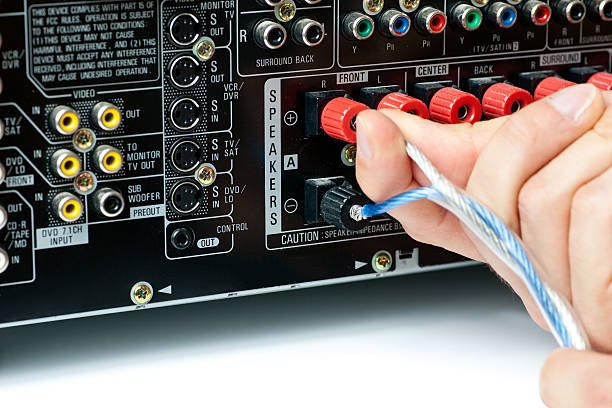
The physical wiring of a 4 ohm speaker is simple, but the preparation and system settings matter far more. Follow these guidelines to safely connect a 4 ohm speaker to Denon 3802 AVR.
Use correct polarity
Match red to positive and black to negative. Incorrect polarity will not damage the AVR, but it will reduce sound accuracy.
Limit your listening volume
The 3802 AVR can power a 4 ohm load, but avoid high-volume sessions. Lower volume reduces heat and prevents clipping.
Ensure strong ventilation
Place the AVR in an open space, not an enclosed cabinet. Leave breathing room on the top, sides, and rear so heat escapes easily.
Choose thicker speaker wire
Four-ohm loads pull more current, so use 14-gauge or 12-gauge speaker wire for stronger electrical flow.
OPTIMAL AUDIO SETTINGS
Proper settings protect the amplifier from stress when connecting a 4 ohm speaker to Denon 3802 AVR. Even though this model does not include direct impedance switching options, its configuration menu allows adjustments that lower the load on the amplifier.
Speaker size: Small
This reduces the amount of deep bass the AVR must handle.
Crossover frequency: 80 Hz or higher
Directs bass to the subwoofer, keeping the AVR cooler.
Bass management: Enabled
Redirecting low-frequency energy helps stabilize the amplifier.
Avoid tone boosts
Bass boosts, loudness modes, or extreme EQ settings force the amplifier to push harder through the 4 ohm load.
REAL-WORLD USER EXPERIENCE
Many long-time Denon owners report stable performance with 4 ohm speakers when the system is set up correctly. The 3802 AVR has strong internals and a robust power supply, allowing it to manage difficult loads when not pushed beyond its limits.
Users commonly note:
-
Clear mids and dynamic sound
-
More responsive performance compared to 8-ohm speakers
-
Occasional warming during long movie sessions
-
Stable operation when volume is kept reasonable
The key is good ventilation. A cooling fan or open placement can dramatically reduce internal heating, allowing the AVR to operate safely long-term.
SIGNS THE AVR IS STRUGGLING
Even if connecting a 4 ohm speaker to Denon 3802 AVR is possible, you need to watch for warning signs that indicate the amplifier is under pressure. These include:
-
Sudden shutoffs during louder scenes
-
Hot casing, especially on the top panel
-
Distortion at moderate volume
-
Loss of dynamic range
-
Buzzing sounds from the speakers
If you notice these issues, lower the volume, increase airflow, and verify that bass settings are not too demanding.
WHEN TO USE ADDITIONAL EQUIPMENT
Some users prefer extra protection when running 4 ohm speakers. These optional upgrades help reduce stress on the Denon 3802 AVR.
External power amplifier
Using an external amp designed for low-impedance speakers offloads the heavy work. The AVR then functions only as a processor.
Cooling fan
Small, quiet fans designed for AV receivers can reduce internal temperature by several degrees.
High-efficiency speakers
Speakers with higher sensitivity require less power while still producing strong output, lowering the load on the AVR.
Series wiring
If connecting multiple speakers, wiring in series raises total impedance, making it easier for the amplifier to handle.
LONG-TERM PERFORMANCE CONSIDERATIONS
Connecting a 4 ohm speaker to Denon 3802 AVR may slightly reduce the receiver’s lifespan if the system is driven hard regularly. Heat is the main factor that affects longevity. By maintaining ventilation, managing bass, and avoiding high volumes, you ensure the AVR stays stable for years.
Regular dust cleaning also prevents heat buildup. Removing dust from vents every few months helps ensure smooth airflow.
Conclusion
Connecting a 4-ohm speaker to a Denon 3802 AVR is safe as long as you take the right precautions. The amplifier can handle low-impedance speakers, but it must not be pushed to its limits. With proper settings, strong airflow, and responsible volume levels, the 3802 delivers impressive performance even with demanding 4 ohm speakers. Following the guidelines above ensures you get strong sound quality without risking damage to your system.
FAQs
1. Is it safe to run 4 ohm speakers on the Denon 3802 AVR?
Yes, it is safe when you manage volume, ventilation, and bass settings. The AVR can handle the load under normal listening conditions.
2. Will the sound quality improve with 4 ohm speakers?
Many users experience better clarity and stronger dynamics because 4 ohm speakers are more efficient.
3. Should I change settings before using 4 ohm speakers?
Yes. Set speakers to Small, raise the crossover, and avoid bass boosts to reduce strain.
4. Can the AVR overheat with a 4 ohm load?
Yes, if placed in a tight space or used at high volume. Adequate ventilation prevents overheating.
5. Do I need an external amplifier?
Not always, but it can help if you listen at high volume or use large, power-hungry speakers.